History
Flanders is home to an extraordinarily rich and multifaceted organ tradition, whose influence resonates far beyond its borders. From the earliest times, organ builders from this region have achieved international acclaim — including Brebos, Langhedul, Forceville, Le Picard, De la Haye, Van Peteghem, Van Bever, Schyven, and Loret.
Equally, Flemish composers have left an enduring imprint on the organ repertoire, with luminaries such as Pieter Cornet, Abraham Van den Kerckhoven, Lambert Chaumont, Jacques-Nicolas Lemmens, Alphonse Mailly, Jozef Tilborghs, Jozef Callaerts, Flor Peeters, and Gabriël Verschraegen.
While 19th-century music journals — including Gazette musicale de la Belgique, La Belgique Musicale, Le Guide Musical, and Musica Sacra — regularly highlighted the organ, a dedicated organ magazine had yet to emerge.
It was only after the Second World War that this changed. From that point onward, four successive Flemish organ periodicals were published, each laying a cornerstone in the evolution and cultivation of Flanders’ organ heritage.
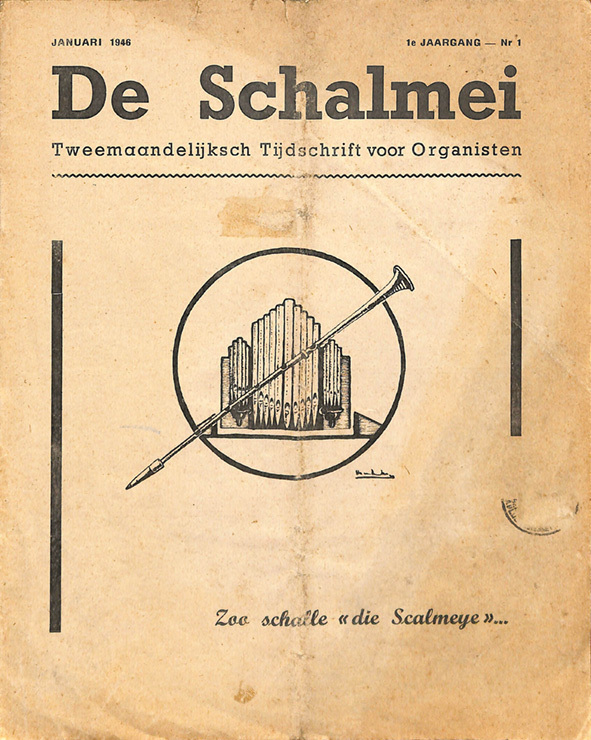
De Schalmei (1946–1950)
In 1946, De Schalmei was launched in Ghent as the first Flemish organ magazine, founded by Berten De Keyzer and Gabriël Verschraegen. Its contributors included leading figures such as Maarten Albert Vente, Flor Peeters, Piet Visser, and Charles Vanden Borren.
In the third issue of its inaugural volume, the magazine articulated its mission clearly:“We seek to locate and study archives that have not yet been examined or made public, so that musicologists and historians can rely on trustworthy sources in their study of the organ history of the Low Countries. Organists gain insight into the historical significance of their instruments, while organ builders receive a valuable guide for restorations and the preparation of a disposition.”After just over five years of publication, the magazine ceased in 1950.
Berten De Keyzer offered a final word of gratitude and reflection:“Morendo triste… ma non troppo. Despite everything, we can look back on a rewarding period. […] Our archival research has produced a volume of organ history that no organ historian anywhere in the world can afford to ignore.”
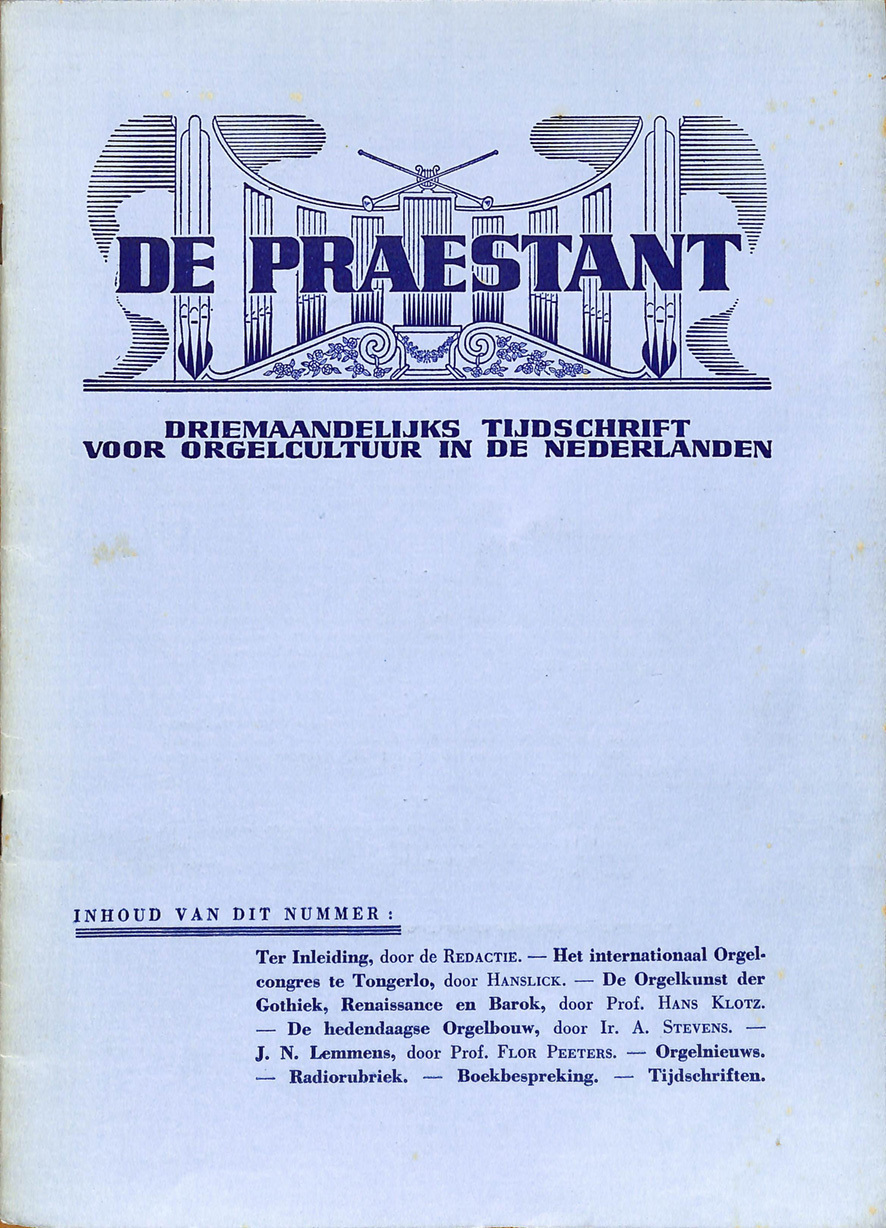
De Praestant (1951-1972)
Shortly after the disappearance of De Schalmei, Flor Peeters and Titus Timmerman took the initiative to launch a new organ periodical, De Praestant. The occasion was the Organ Congress held from 4 to 7 August 1951 at the Abbey of Tongerlo. At that time, the editorial board consisted of Charles Hens, Gabriël Verschraegen, A. Stevens, Albert De Klerk, Hennie Schouten, and J. Vermeulen.
Following a trial issue in 1951, the editorial team began a quarterly publication in 1952, aimed not only at Flanders but at the entire Low Countries. Each edition included an organ score—“small, modern, and not too technically difficult,” according to the editors.
More than twenty years later, in 1972, the final issue of De Praestant was published.
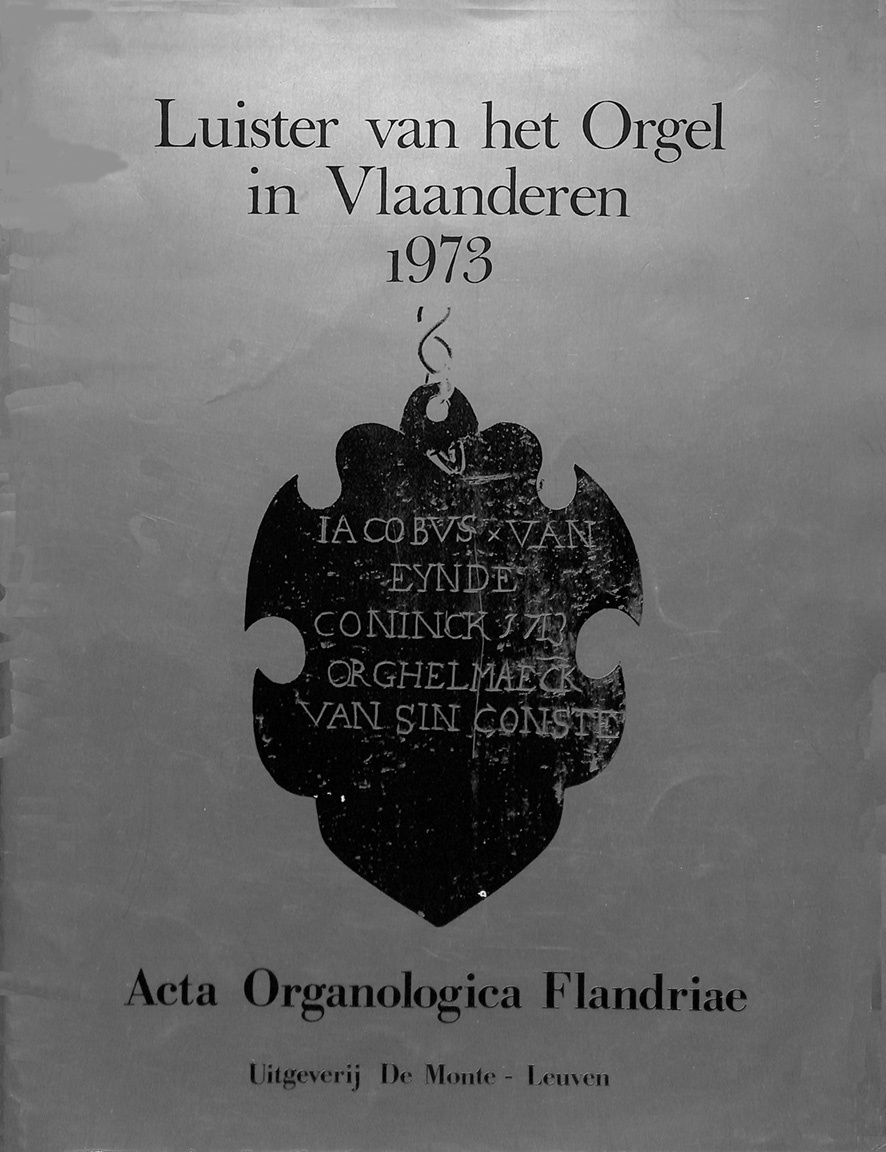
Luister van het orgel I (1973)
Once again, the disappearance of an organ periodical led to the creation of a new publication. In 1973, the editorial team —Kamiel D’Hooghe, Agnes Dumon, Antoon Fauconnier, and Ghislain Potvlieghe — published Luister van het Orgel I, conceived as the first volume of Acta Organologica Flandriae and issued by De Monte in Leuven.
In a recruitment letter, D’Hooghe clarified the ambition behind the project:
“If we want the next generation to be able to play historical organs, we must now insist that conservatory students no longer receive lessons on poor-quality instruments and that they show interest in the historical organ heritage. Organ building as an artisanal art must be saved as a matter of priority. Otherwise, we will lose our organs and our organ-building tradition.”
Despite this clear and passionate mission, only one beautifully produced issue appeared, devoted to the Ypres organ builder Jacobus Van Eynde (late 17th century–†1719), with contributions by Ghislain Potvlieghe and Antoon Fauconnier. The economic uncertainty brought on by the oil crisis raised doubts about the feasibility of a new Flemish organ periodical.
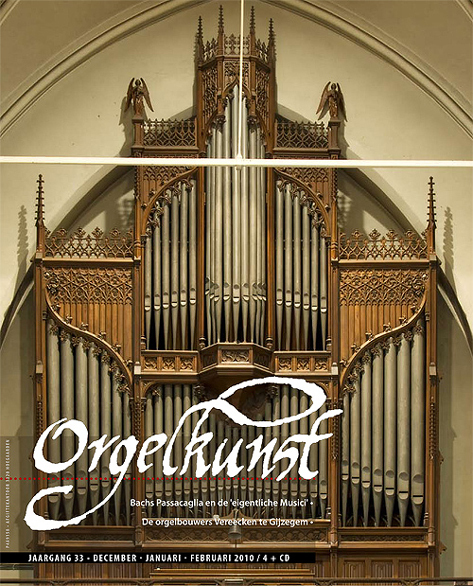
Orgelkunst (1978 - Present)
In 1978, Orgelkunst was founded in Grimbergen. The magazine emerged from the joint efforts of a dedicated group of organists, researchers, and organ builders concerned about Flemish organ heritage. Their aim was to create a platform that would carefully study historical organs, adhere to international standards, and defend the artisanal craft of organ building.
Editor-in-chief Kamiel D’Hooghe set the tone immediately in the first issue: Flanders urgently needed a magazine with vision—a scientifically grounded compass in a period marked by thoughtless innovations and the loss of valuable heritage. Only through knowledge, care, and clear policy could these instruments be preserved.
From Initiative to Association
The project grew quickly. In 1980, Orgelkunst gained a formal structure with the founding of the Flemish Association for the Promotion of Organ Art (V.V.B.O.). The founders established a sustainable foundation for the magazine and for broader organ-related policy in Flanders. The objectives set at that time remain guiding principles to this day.
Early Milestones
In 1979, the association organized an influential symposium at Grimbergen Abbey, where organ builders and advisors discussed the future of the craft. The conclusions were clear: organs must be treated as works of art, restorations must be conducted professionally and with high quality, and the traditional craft of organ building deserves protection and recognition. These recommendations were submitted directly to the Flemish government and marked an initial step toward improved heritage policy.
The 1980s and 1990s brought expansion: new editors joined the team, thematic publications appeared, and interest in historical research grew. The magazine increasingly became a reference point for those engaged in organ culture.
Professionalization and Innovation
In 1997, Orgelkunst received a new design and entered the digital era. Articles became more thematic, music bibliographies were developed, and the magazine built a solid reputation both within Flanders and abroad. The fourth lustrum in 1998 was met with acclaim: Orgelkunst was recognized as an art-critical journal and received structural funding, further strengthening its operations.
The 2000s were marked by further professionalization. In 2004, the association was transformed into Orgelkunst vzw, with a renewed board of directors and a modern editorial approach. From 2005 onwards, the magazine received a refreshed design, included CD supplements, and carried out major projects focusing on 19th-century instruments, contemporary organ music, and historical research.
Digital Growth and International Reach
From 2010, Orgelkunst expanded its digital presence. The website was revamped and included a digital organ library where composers could share their music. At the same time, important CD projects were published, including works by Cavaillé-Coll and Gabriël Verschraegen.
The publication of Widor’s Souvenirs autobiographiques in 2013 — its first Dutch translation with international collaboration — confirmed the magazine’s international scope.
A Living Community
Over the years, Orgelkunst welcomed new editors and board members while bidding farewell to some key figures who had helped shape the magazine. Thanks to the efforts of multiple generations, Orgelkunst has grown into a dynamic community of writers, researchers, organists, organ builders, and enthusiasts.
Forty Years of Commitment to Organ Culture
In 2017, Orgelkunst celebrated its 40th volume with four thematic issues and a commemorative anniversary CD. By then, the magazine had become a broad platform that not only highlighted historical heritage but also paid attention to contemporary organ building, new music, research, instrument types, and European developments.
A Continuing Mission
Today, Orgelkunst remains an open forum where expertise is shared, perspectives exchanged, and new research encouraged. Through its enduring commitment to quality and depth, the magazine has been fostering a strong and forward-looking organ culture in Flanders and beyond for nearly five decades.